

Anna Lee
Bachelor of Design
Light Lace
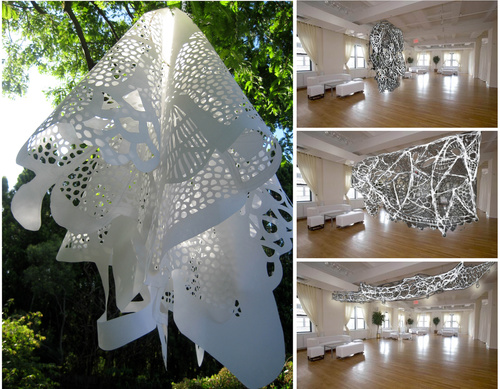
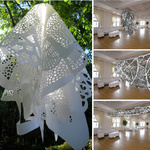
In the long history of lace, lace has been an important form of decoration. It was a signifier of the wearer’s fashionability, social status and wealth, so luxurious that as early as the reign of Edward III, servant girls were prohibited by law to wear lace veils. Lace was a was an asset of trade, exported and exchanged for property, “horses and liveries” (Palliser, 1902), as well as a means to demonstrate one’s common etiquette, as observed in a historical text “The Boke of Curtasye”, commanded that a master should be in “a ‘clene shirte’, boredered with lace and curiously adorned with needlework” (Palliser, 1902).Thus, lace rarely evokes expectations of practicality or utilitarian functions. However, when one considers the basic principle of lace, it becomes evident that there are many lace-like structures that were created for entirely utilitarian purposes. Lace is lightweight and pliable, and uses the full strength of the yarn from which it is produced, properties all made use of by nets, that catches, sorts, filters and contains things. Having open and closed spaces, lace structures can also reveal/obscure sights, control light permeability, like with curtains, lanterns, and paper cuts pasted on windows of antique Asian architecture. Moreover, biology often relies on open areas in surfaces to carry basic functions to survive. Skin, cell walls and membranes of humans, animals and plants are permeable so that they can filter, protect, aerate and keep the organism warm. The irregularities in the shapes and sizes of the holes are not only practical, but also inspire aesthetic forms. Stemming from the cross-sectional images of plants, oceanic organisms and human skin, I intend to create a hanging textile lace project that is not only aesthetically intriguing, but will serve as a practical installation in an open plan design office whose shape can morph according to the how the space is used. With the worked wiring and bulbs, it can be hung neatly in the centre of the office as a lighting feature. The textile can also be opened up as a temporary divider to shape and separate spaces in the office according to the user’s needs. It can be manipulated towards areas of the room where naturally lighting cannot reach at various times of the day. Furthermore, it is designed to be installed in a open plan design studio, so it can also be stretched out to serve as a display wall, from which you can hang artworks/ objects. The images will also inform my work of structures that allow for strength and stability so that the open textile is practical. To reinforce my investigation of the practical possibilities of lace, it is important that motifs, rhythm and proportion of traditional lace are appropriated to reflect the ornament’s historically frivolous nature, becoming a provocative piece of both the old and new.